

How Corporate Business Attorneys Can Help Fund Your Business
Raising capital to start or grow a business takes more than a great idea. It requires careful planning, clear documentation, and an understanding of how each funding option affects your ownership, risk, and long-term goals. Whether you are exploring an SBA loan, considering a line of credit, or planning to bring in outside investors, every choice has legal consequences that can shape the future of your company. At Carosella & Associates, while we do not advise with respect to SEC matters, our experienced corporate business attorneys in West Chester, PA, help business owners throughout Chester County, Delaware County, and across Pennsylvania evaluate funding options, avoid legal pitfalls, and present a strong, organized business to lenders and investors.
Why Legal Strategy Matters When You Seek Funding
Many business owners wait to call a lawyer until something goes wrong, such as a broken deal or an investor dispute. In reality, the best time to involve a corporate business attorney is before you sign anything or ask for money. Funding decisions are not only financial, they are legal. Banks and investors look closely at how your business is structured, whether your contracts are clear, and how well your risks are managed. If your ownership records are incomplete, your agreements are inconsistent, or your compliance is weak, a lender or investor may see your company as a higher risk even if your revenue is promising.
An experienced business attorney helps you prepare before due diligence begins. We review your entity structure, clarify ownership, organize your records, and identify possible red flags that could slow down or derail a funding request. That preparation can make the difference between a deal that moves forward smoothly and one that stalls at the negotiating table.
Key Questions To Ask Before You Look For Capital
Before you apply for a loan or approach an investor, it is important to be clear about what you need and why you need it. Questions to consider include:
- How much capital do you truly need to raise now, and what specific uses will those funds support in the next 12 to 24 months?
- Are there friends, family members, or colleagues who might be able and willing to help finance your business, and would that create any relationship concerns if the business struggles?
- Do federal, state, or local grant or loan programs exist for your industry or location that you should consider alongside traditional bank financing?
- If you already operate a business, are options such as a line of credit, invoice financing, or equipment financing realistic based on your balance sheet and cash flow?
- How will investors earn a return if things go as planned, and does your business plan clearly explain how they could reasonably make money over time?
You may have rough answers to these questions, but a corporate business attorney can help you refine them and identify which funding paths fit your legal and financial situation. We can also coordinate with your accountant so your funding strategy and financial reporting work together.
How A Corporate Business Attorney Supports Your Funding Strategy
A corporate business attorney does much more than read a single loan agreement. Our role is to help you build a legal framework that supports your funding goals now and in the future. We confirm that your entity type, such as a limited liability company, corporation, or partnership, matches your plans for loans, investors, or both. We draft and update operating agreements, shareholder agreements, and partnership agreements so that ownership percentages, voting rights, and decision-making authority are clearly documented.
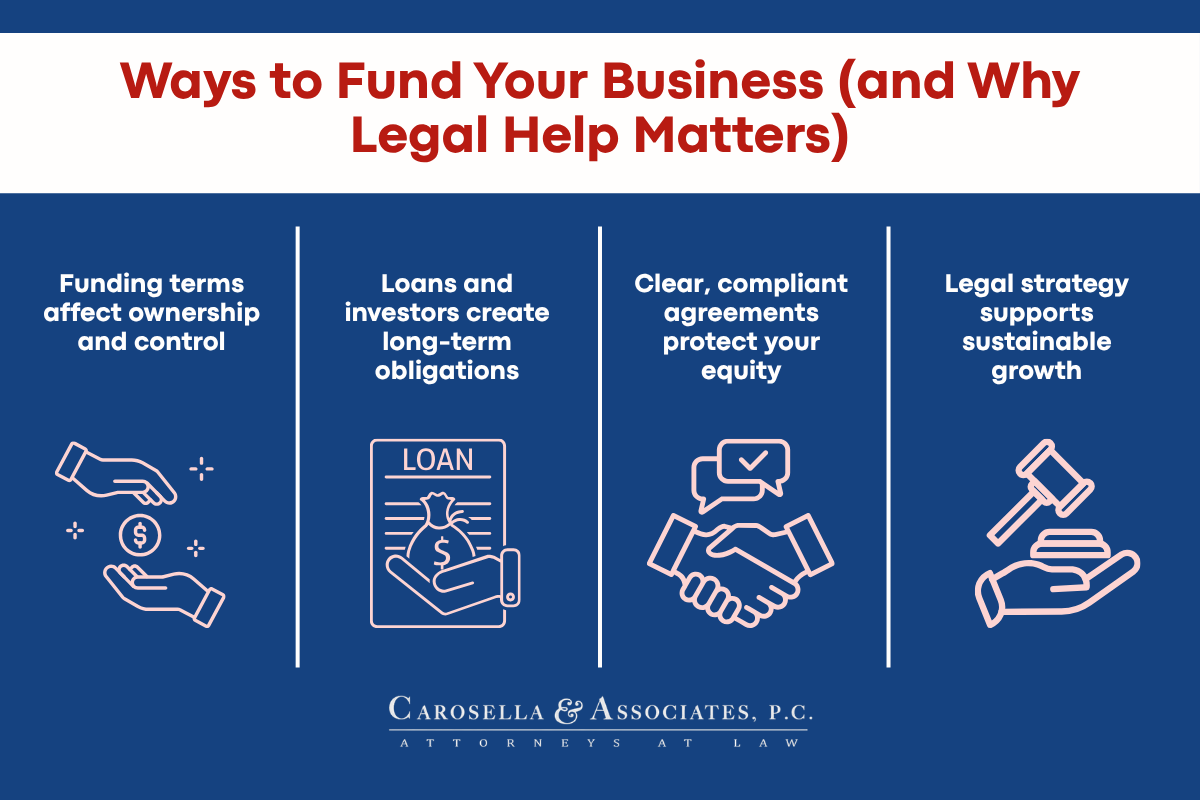
Common Funding Options And How Lawyers Help You Navigate Them
Bank Loans And Lines Of Credit
Traditional lenders often provide term loans, SBA-backed loans, lines of credit, and equipment financing. These options can be powerful tools, but the fine print matters. We review term sheets and loan documents so you understand repayment schedules, collateral, covenants, default triggers, and personal guarantee provisions. In some cases, we can help negotiate terms that are more manageable for your cash flow and growth plans, such as adjusting covenants or clarifying what happens if your revenue fluctuates.
Friends and Family Investors
Capital from people you know personally can be very appealing, but it can also be complicated if expectations are unclear. We turn informal conversations into clear written agreements that address how much is invested, what type of interest the investor receives, how returns will be calculated, and what happens if the business underperforms or needs more funding later. That clarity protects both your relationships and your company.
Grants, Government Programs, And Community Funds
Some businesses qualify for grants, revolving loan funds, or other public programs that support growth, job creation, or innovation. We help you understand the legal conditions attached to these funds, such as reporting duties, use restrictions, or clawback provisions. Understanding these obligations from the start helps you avoid compliance issues later.
Strategic Partnerships And Vendor Arrangements
In some cases, the most effective form of funding is not a traditional loan or equity but a strategic relationship. Suppliers may extend longer payment terms, customers may prepay for services, or partners may share costs on a joint project. We draft and negotiate co marketing agreements, reseller contracts, revenue share deals, and other partnership documents so that responsibilities and expectations are clearly defined and enforceable.
Protecting Your Equity And Control
When you are focused on getting capital into your business, it can be tempting to accept aggressive investor or lender terms just to close a deal. A corporate business attorney helps you understand what you might be giving up. We look at valuation, voting rights, board composition, and other control-related provisions so you do not unintentionally hand over decision-making power or a disproportionate share of future value.
Planning For Succession And Exit
Investors and lenders often ask what happens to the business if you retire, become disabled, or pass away. That question is not only personal, it is also structural. We work with business owners on succession planning so your company has a clear roadmap for leadership transitions. This may involve buy-sell agreements between partners, key person provisions, or coordination with your personal estate plan. Having a documented succession plan reassures funders that your business is designed to continue even if circumstances change.
Reducing Risk For Lenders And Investors
From a bank or investor’s perspective, a well-prepared business is less risky. When your contracts, policies, and records are organized, you show that you manage your company with discipline and foresight. We help reduce perceived risk by identifying and addressing unresolved disputes, standardizing your key agreements, documenting major customer and vendor relationships, and confirming that the individuals signing documents have proper authority under your bylaws or operating agreement. This type of preparation often leads to smoother reviews and more constructive negotiations.
Preparing For Due Diligence
Once a lender or investor shows serious interest, they will conduct due diligence on your company. Many promising deals slow down or fall apart because basic records are missing or inconsistent. Our attorneys help you assemble and review corporate documents, contracts, leases, licenses, employment agreements, and intellectual property records in advance. We explain how banks and investors are likely to interpret this information and recommend updates or corrections where needed. The more complete and coherent your documentation is, the more confidence funders will have in your business.
Local Insight For Pennsylvania Businesses
If your business operates in Chester County, Delaware County, or nearby communities, local rules, filing systems, and court practices can influence how you structure your company and your funding arrangements. At Carosella & Associates, we assist with forming entities in the appropriate state, registering as a foreign entity when you expand across state lines, and making sure your contracts and funding documents align with state-specific requirements. This regional insight allows us to design funding strategies that work in practice, not just on paper.
Take The Next Step
Funding your business is not just about finding someone willing to write a check. It is about building a legal and financial foundation that supports sustainable growth and earns the trust of lenders and investors. Our corporate business attorneys in West Chester, PA, help entrepreneurs and business owners in Pennsylvania clarify their options, protect their interests, and move forward with confidence.
If you need assistance with funding your company, business entity formation, or related legal matters, contact Carosella & Associates today to schedule a complimentary consultation.
